Imagine this scenario...What's going on with Jeff Evans and the world of MountainVision... Here you will find my own personal diatribe regarding thoughts and stories I encounter in the world of adventure travel, climbing and mountaineering...infused with the themes that are the cornerstone of my MountainVision message...Teamwork, Vision, Commitment and Leadership.
Friday, July 29, 2011
Now That's Trust
Imagine this scenario...Friday, July 22, 2011
Shedding A Tear For All To See
When I agreed to do Expedition Impossible with Erik I knew I was going to be exposing myself on national TV for better or for worse. I knew that the "redneck" that hides inside of me would surely make an appearance along the way (and it has). I also knew that my foul mouth would probably surface at some point as well (and it has).Friday, July 15, 2011
If You Aint First, You're Last...
Well...clearly the past week has been full of texts, emails and calls from friends saying some iteration of "If you guys don't win this mountain stage, I'm done watching." Expedition Impossible Episode 4 took us into the Atlas Mountains of Morocco...obviously the terrain that everyone expects us to dominate. We gave it everything we had...and 2nd was as good as we could do behind those little Gypsie jackrabbits.Friday, July 8, 2011
If He's Willing to Push it...I'm Willing to Take Him There
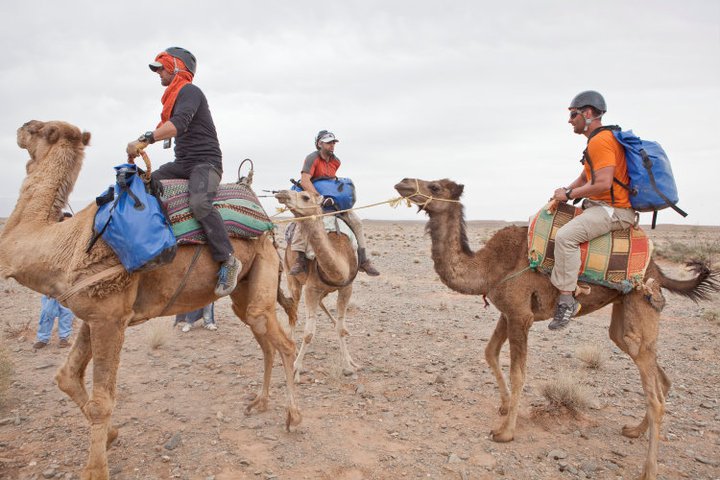
Another tough stage is behind us now on Episode 3 of Expedition Impossible. Erik, Ike and I moved up to 2nd place overall once all of the camel riding, puzzle solving and dust storm forging was over. I remember this stage very vividly as it stood as the most freaked out I've ever seen my boy Erik....and I clearly have seen him in countless sketchy situations. The camels took the cake.Friday, July 1, 2011
Leaving Erik Behind...
Yep...that's what happened. Monday, June 27, 2011
Next up... "New Horse"
Episode 1 is behind us and so are those nasty cobras and my obvious inability to count past 10.I hope you enjoyed the first episode of Expedition Impossible, which aired last Thursday on ABC! Somebody sure did because the show was ranked #1 among adults 18 to 49, teens 12 to 17, and kids 2 to 11—the highest rating the network has had on Thursday night since the finale of Lost in 2008.
While I can’t tell you anything about future episodes, as long as Team No Limits hangs in there, I will post some stories about what happened that you don’t see on the camera.
For example, you may not have realized that the first of the ten stages was actually two days long. The first day of racing wasn’t too critical except the winning team got a 5-minute head start the next morning. And the teams that came in 2nd, 3rd, and 4th, then got a 5-minute head start over the remaining teams. It’s the second day of a stage that really matters because that’s when the helicopter may be flying you away.
As we were resting in our Berber tent before the start on the first day, Erik left to go to the bathroom and Mark Burnett came in to have a one on chat with me. Towards the end of our conversation Mark asked me, “Are you sure he’s going to be able to handle this?” I said, “Yeah, I think so.” Then Mark says, “Well I hope we haven’t made a big mistake by having him here.” Of course I saw a great opportunity to fire Erik up by sharing this encounter with him and I actually believe Mark said this on purpose, knowing I would hear about it. Not 100% sure, but if this was part of his plan, it totally worked. When somebody says Erik can’t do something, he tends to get fired up!
At this early stage of the competition, all the teams are checking each other out. We had seen each other in LA at the audition and again in a hotel on the way to Morocco but nobody was allowed to talk to other teams. So Ike and I sized up the others for Erik. We laughed about the guys in knee-high purple socks but, at the same time, they looked pretty fit. We also saw these giant guys, who we later discovered were NFL football players. We joked, “Big trees fall hard.” When we happened to pass Akbar in the hotel, he actually growled at us, which was rather unsettling. It turned out he was totally kidding and is actually a super nice guy!
The first day involved the brutal sand dune climb in searing heat. Notice that out of all 39 contestants, Erik was the only savvy one with enough insight to wear gaiters to keep sand out of his shoes. This may sound like a small thing but everyone else had sand piling down their feet that gave them huge blisters. Ike and I had to stop several times to pour sand out of our shoes. Blind dude gets experience points right out of the gate.
Did I mention how brutal the climb was? The show focused on Chad (from the Country Boys) suffering but I can tell you he wasn’t the only one. Erik and I had just arrived from Colorado, which gave us a bit of an edge, but poor Ike was a flatlander and he really struggled. Of course Ike soldiered on—he’s earned two Bronze Star Medals, a Purple Heart, and an Army Commendation Medal after all— but this raised the specter of doubt about our team’s success for the first time.
The second day was really hard for Erik because it was super rocky as we descended into a valley. This type of terrain is super difficult for him to move through quickly and I got worked. At this point, we were about even with the Fishermen but eventually Erik couldn’t keep up the pace and they passed us. As they went by, one of them turned to us and with that thick Boston accent said, “Remember our names, we’re the Fishermen. We’re for real!” In my typical competitive spirit...that did nothing but make me want to crush those guys.
So lots of early assessments going on on everyone’s part. We can’t fault the girl who wrote us off in the beginning: She said something like, “There’s a blind guy on one of the teams, so I know we’ll beat at least one team.” Like a lot of people, she just had no idea what a blind person is capable of. As we got to know the Fishermen, we actually liked them a lot; they came across as Gloucester gruff at first but were really awesome—sincere, hard working and the kinds of guys who you’d want around in a raging storm. They also had incredible fishing stories, going out to sea for weeks on end and having to be totally self-reliant. The Football Players are actually the nicest guys in the world. Akbar is a gentle giant full of curiosity, except when it comes to all the insects around camp. All the creepy crawlies terrified him.
Our big mistake wasn’t mis-counting the snakes, it was moving too fast. We were among the front runners and just made a mistake, which was a huge bummer that cost us a half hour. But that’s one of the things you learn from experience…you screw up, you make a mistake, deal with it. The reality was that 3 other teams counted wrong as well. However the editors made it appear it was just us that miscounted. Guess I'll always be known for miscounting the snakes.
However, the faster you get over it and the faster you come together as a team and figure how you’re going to remedy the situation and get back on track, the faster you’re back in the game. I was really proud of Ike and Erik because we kept our heads together even though we made this blunder. And Erik never blamed Ike and I for the miscount. He just took it in stride and powered on.
Next week we will take on the horses...and believe me there will be some serious buckin goin down. Listen for the soon to be well documented comment after hitting the dirt, "New Horse".
Well that’s it for now. Stay tuned for next week’s episode and then come back to my blog for more behind the scene stories!
Thursday, June 23, 2011
Here We Go!!!!
It's on...tonight!Tuesday, June 14, 2011
Expedition Leadership in the Wild

A really wonderful article from...
John N. Gans, the Executive Director of National Outdoor Leadership School (NOLS)
The lessons about leadership learned in the crucible of the backcountry environment — unpredictable, challenging, and dynamic — map to today's business environment. The wilderness is an unparalleled venue for highlighting team and individual strengths and learning to compensate for shortcomings. Executives from Google and Timbuk2; students from Wharton and the Kellogg School and even most NASA astronauts have evolved through such training. Think of it as an MBA from nature.
Outdoor training activities, even those as straightforward as lightweight backpacking, enable students to actually practice different leadership and communication models so that they can learn about their own leadership style and its impact on outcomes in a group. Understanding their go-to "signature" style allows them to then develop situational leadership skills that can adjust to current events and group needs.
A 2008 University of Utah study focused on the long-term benefits of wilderness education. The study, "Long Term Impacts Attributed to Participation in Adventure Education..." (link PDF) found that, beyond outdoor and survival skills, program graduates gained critical leadership skills including: effective handling of difficult circumstances, the ability to work as a member of a team, strategic planning, and how to communicate positively with diverse types of people.
In the 16 years I've led the National Outdoor Leadership School (NOLS), and in the more than 30 years I've been active in the outdoors, I've seen the idea of "expedition leadership" take hold in organizations. In large part, that's because companies are moving away from the traditional hierarchical, command-and-control structures and towards looser networks and flatter org charts.
The concept of expedition leadership as espoused by outdoor training programs effectively turns the command-and-control model on its head. Expedition leaders encourage active followers. All of the members of the team are empowered to make decisions and through their efforts everyone has a role to play bringing clarity to the larger group vision. Middle managers, the business equivalent of an expedition member, generally have the most information about the decisions that need to be made. Giving them permission to make the decision, and see it through, leads to cohesion and rewards, collaboration rather than competition.
As part of outdoor training programs, students are asked to step back and create functional teams that work across traditional departmental lines and outside of a strict hierarchical structure. Setting goals, making a plan, managing resources (food, fuel, etc.), working as a team, and remaining flexible are crucial to a successful backcountry expedition and the expedition of life. The model focuses on collaborative teamwork to achieve goals. Risk management becomes intuitive given the inherent risks and hazards of remote and wild areas.
Outdoor training "was a life changing time for me," said Nantucket Nectars and Plum TV founder, Tom Scott. "The stakes are very real. The chain is as strong as its weakest link. The goal is to arrive at the next place as one. All links intact. I came back a different person."
Even if a team-wide outdoor training isn't in the cards for your group, getting away from the boardroom and into a more natural setting will allow your team to step out of the standard office roles. We do a yearly three day executive team retreat at a nearby nature center where meetings in a rustic setting are combined with "walk and talks" addressing specific issues. Each day a group hike or bike ride is included for exercise and relaxation, but meals are when the real team-building takes place. Preparing a meal together truly illuminates each person's leadership styles and tendencies. Competence, teamwork, and communication are all on display.
Extended wilderness expeditions develop one's understanding of leadership, teamwork, ethics and judgment. Connecting with the wild outdoors in an intense way fosters the kind of self-reliance, judgment, respect, and sense of responsibility that can help leaders thrive in today's shifting organizational landscape.
Wednesday, May 25, 2011
Ten Years Ago Today...

....I stood on the summit of Mt Everest with some of my closest and dearest friends. Men that I call brothers. The bond that we have was established with the galvanizing effort of getting our blind buddy Erik as high up on the mountain as we possibly could...and back down safely again.This was a selfless journey...putting our own personal agendas on the back burner in order to achieve a success that would only be reached with the efforts of the team.
I look back on that day with an inspired and genuine satisfaction. That each one of us was putting out everything we had for the guy next to us. It is an amazingly empowering tool to know that you have surrounded yourself with individuals that are as committed to a cause as you are. It gives you strength and security that if you should stumble...if you should fall, your people have your back.
I learned a lot that day... about how to be a teammate, how to be a leader and how to dig down deep for something bigger than me. Now ten years later I realize how critical those lessons are to me as a husband, father and man.
Thursday, May 19, 2011
Expedition Impossible Promo
Tuesday, May 17, 2011
Fundraiser for STTS and a Reunion of Sorts...
This Friday I will be taking part in a very worthwhile fundraising climb with some old and new friends.Monday, May 9, 2011
Expedition Impossible!!!
Well, here we go! Friday, May 6, 2011
I am now a Twit!!!
Wednesday, April 27, 2011
Are Leaders Made or Born?
Are leaders born? Or can they be made? A new study that looks at the brain waves of various individuals seems to find evidence that charismatic leadership has a physical manifestation in the brain. But it may be possible to teach people how to change their brain activity in ways that may make them more inspirational to others. Do you get the sense that everything now is genetic?
Surely one of the last bastions of learned behavior is executive development. Over the generations, we have spent millions turning individuals into leaders at the military-service academies, at business schools and with corporate programs.
Despite the extensive practice of leadership development, we don't have a great sense as to how well this training actually works, and many critics have long suggested that leadership can't be taught. Some people are born leaders, they say, and others just aren't.
So here's a study, "Leadership and Neuroscience: Can We Revolutionize the Way That Inspirational Leaders Are Identified and Developed?," that appeared in the February issue of the Academy of Management Perspectivesthat gives some solace to both sides of the debate.
The study, by David A. Waldman, Pierre A. Balthazard and Suzanne J. Peterson, centers on the concept of coherence, which measures the extent to which different parts of the human brain communicate with each other.
The idea is that different parts of the brain are responsible for different types of behavior and responses as well as different types of cognition (remember the "left/right brain" arguments?). Brains that are better able to communicate across regions may also be better able to handle a range of responses and thinking, especially the complex process of understanding and conveying emotions.
The study used electroencephalographs -- those little electrodes on your head -- to measure the extent to which signals are moving across parts of the brain.
The authors found that greater movement, suggesting greater coherence, was associated with individuals who had visions of the future for their organizations that were more inclusive and collective; those with less coherence had more individualized or, one might say, more selfish visions.
And finally, those with more collective visions were seen as more inspirational and charismatic by their followers.
The idea that charismatic leadership has this physical manifestation in the brain is especially important because such leadership appears to be, at a minimum, one of the least teachable aspects of management.
So these results seem to support those who believe that some people have it and others don't.
But before we get carried away with the inevitability of biology, the authors of the study note that the same techniques of mapping brain signals have been used in other contexts to actually rewire the brain.
Neurofeedback is the process of helping an individual understand how his or her brain is firing in different ways and recognize the associated sensations so that one can learn to focus on particular patterns of firing.
The idea is the same as with biofeedback, which helps people learn how to control their involuntary processes like heart rates.
There is some evidence that neurofeedback can change some brain functioning. It may be possible to teach people how to change their brain activity in ways that create more coherence across regions of the brain, possibly allowing us to process information and emotions in ways that make us more inspirational to others.
It's important to note that these results are just suggestive. We don't know with any certainty that the brain patterns observed are actually the cause of the leadership traits. And we don't know to what extent we will be able to change those brain patterns.
But we may have to get used to the idea of leadership-development programs that involve hooking participants up to monitors and having them watch video screens.
Since leadership-development programs are so often held in swanky places, maybe those video screens can be set up near the golf course.
Peter Cappelli is the George W. Taylor Professor of Management and director of the Center for Human Resources at The Wharton School. His latest book, with Bill Novelli, is Managing the Older Worker: How to Prepare for the New Organizational Order.
Monday, March 21, 2011
The Mysterious Adventure...
So, it's about that time....Sunday, March 13, 2011
Outside Magazine Article on STTS

Here it is...
Thursday, March 3, 2011
More Soldiers to the Summit
On the way to the top...Thursday, January 27, 2011
Kiteboarding!!!

Tuesday, January 11, 2011
MountainVision Youtube Channel
Monday, January 3, 2011
Off to Baja...
As the new year rang in for us here in Colorado...my wife and I turned our attention to our upcoming family adventure to Baja. Here in a couple days the bite of the Colorado winter will be replaced with two months of the warm breezes and surf of the Baja Peninsula for the Evans family.Don't forget to carve out time for the people closest to you. Time is so fleeting. We have a finite amount of it and I for one will spend the first bit of this joyous new year with the two people closest to me.
Monday, December 20, 2010
A Recent Event Testimonial...
I highly recommend Jeff Evans as a speaker for your National Sales Meeting.
Jeff spoke at Megadyne Medical's National Sales Meeting in March of 2009 at the Deer Valley Resort in Park City. He not only has an inspiring and compelling personal story to tell - taking the first blind man to the top of Mount Everest - but does so in an engaging and enlightening manner using analogies from his experience and the climbing teams ultimate success to the teamwork, leadership and execution required to be successful in the corporate world. He was a huge hit with our sales team and was the top rated event over the course of the meeting.
Even today, after two years, we often refer to his presentation and/or Everest observations as we discuss our own goals, objectives and targets. The Megadyne management team and sales force came away from the presentation with a greater understanding of the commitment required to achieve significant goals, the vision and leadership required to stay focused on the summit, and the planning, execution and teamwork necessary to move up the mountain!
Moreover, we found a partner and friend in Jeff. He was extremely easy to work with and very interested in learning about Megadyne and our needs. He demonstrated a geniune desire to understand our electrosurgical product lines, markets and customers. He has a medical background and could easily "talk the talk" with our sales team - easily attaining a level of credibility that enhanced his presentation.
Jeff was able to easily weave our desired message and focus into his presentation. In fact, we based the theme of our National Sales Meeting - "Reaching New Summits" - around his message and ensured that everyone had a copy of his book to take home after the presentation as a reminder. Needless to say, Jeff made an extremely positive impact on our overall message to the sales force and helped set the tone for the years sales objectives.
Based on your stated goals, I am positive that Jeff will have the same impact for you.
Thursday, December 9, 2010
Reflection...
As I'm sitting here in my hotel room waiting to head to the airport and begin the long journey home, I think fondly on this most recent adventure and my 21 new friends. Over the course of nearly 2 weeks, we walked, shared meals and suffered together...creating a bond that is unique in its depth. It's clear to me after years of adventuring that a persons true heart is exposed when put through challenging events. I watched as each of my new friends dug down deeper than they ever imagined possible to reach this summit. And it's in this struggle that each person found that fundamental place that exists within each of us...that hides from most folks and takes "a little bit of pain" to expose it.
It was an honor to walk with each of these guys and share in such discovery.
A deep and profound thank you to JC Huezinga for putting this group together and being the catalyst for all the goodness.
Till next time...
Jeff and the crew
Tuesday, December 7, 2010
Summit!
What a day!
The team departed camp yesterday around 12:30am and headed up for what would be the challenge of a lifetime.
Many would say it was the hardest physical/emotional day of their lives.
20 of 21 made the summit. Greg made it to Stella Point (just an hour short of the summit...an extraordinary accomplishment on its on).
We are all just waking from a solid night of sleep and rest. Today we will make the final 3 to 4 hour hike back down into the jungle. Showers and restaurant food tonight!
More to come.
Thanks for all of your support.
Jeff and the crew
Sunday, December 5, 2010
Into Karanga Camp
We all pulled into the 13,700ft Karanga camp this afternoon in misty clouds and warm temps.
Except for the few headaches and upset bellies, everyone is doing quite well. We will rest tonight to get ready for our move tomorrow up to high camp at around 16,000ft. Our plan is to head for the summit tomorrow night around midnight, with hopes of summiting around 8am the next morning.
Prayers and good thoughts are very much appreciated.
Thanks
Jeff and the crew
Saturday, December 4, 2010
Barranco Camp...all is well
Yesterday we made the move from the Shira Plateau over to the Barranco Valley. It's a fairly long day (about 7 hours) so I think everyone was pretty happy to see camp after some heavy up and down hiking.
Today we push up over "Breakfast Wall", about 1200ft of rocky scrambling and pull into Karanga Camp at about 13,700ft.
The few headaches that folks had yesterday and last night seem to have abated this morning with a little medical intervention.
All is well and everyone is fired up. More to come.
Jeff and the crew
This message has been sent using the picture and Video service from Verizon Wireless!
To learn how you can snap pictures and capture videos with your wireless phone visit www.verizonwireless.com/picture.
Note: To play video messages sent to email, Quicktime@ 6.5 or higher is required.
Friday, December 3, 2010
Into Shira Camp
Tomorrow we will cruise up the Shira plateau, up and over Lava Tower and down into Barranco Camp. It will be another day full of panoramic vistas and beautiful terrain.
Till then...
Jeff and the crew
Wednesday, December 1, 2010
Last Meal and Shower
We all shared a nice meal and some fellowship last night and this morning breaks with excitement as everyone is ready to start the journey upward.
The weather seems to be a bit rainy here in town, which is really quite irrelevant to what's going on at the base of the mountain over an hour away. We cross fingers that our first day is not a wet one as its much more enjoyable to cruise through the jungle in drier conditions.
There are 22 of us on this journey, each person climbing this mountain for their own personal reasons. We will push each other towards the top, sharing in the friendship that comes with such an adventure.
Dispatches from here on out will be spotty. I will do my best. Everyone sends their love to the folks at home.
Onward and upward.
Jeff
This message has been sent using the picture and Video service from Verizon Wireless!
To learn how you can snap pictures and capture videos with your wireless phone visit www.verizonwireless.com/picture.
Note: To play video messages sent to email, Quicktime@ 6.5 or higher is required.
Arrival Complete
So we are all now accounted for in Tanzania. All the folks, all the bags. This bodes well for a group of 22, as typically with a group this size, something or someone goes missing. Our debriefing meeting took place this morning where I reviewed with the group the climb details and what to expect from the next week. Everyone is clearly excited and perhaps a bit nervous for the journey that lies ahead. More to come...
This message has been sent using the picture and Video service from Verizon Wireless!
To learn how you can snap pictures and capture videos with your wireless phone visit www.verizonwireless.com/picture.
Note: To play video messages sent to email, Quicktime@ 6.5 or higher is required.
Wednesday, November 3, 2010
Exclusive Interview with Expedition Leader for Soldiers to the Summit
Warrior SOS is a non-profit organization dedicated to raise public awareness and help families and individuals who have experienced the burdens of physical, emotional and psychological trauma associated with military, law enforcement and security operations.
Military veteran amputee, "Jukes"
Lobuche
Jeff Evans, the founder of MountainVision Inc., and author of Mountain Vision: Lessons Beyond the Summit—a must read for every warrior. He is perhaps most well known for guiding the first blind climber, Erik Weihenmayer, to the summit of Mt Everest in 2001. Jeff most recently served as the Expedition Leader for the monumental Soldiers To The Summit Himalayan Expedition in Nepal. Along with his team, Jeff succeeded in planning and executing an expedition that would put seven injured US soldiers on the summit of a 20,100 ft Himalayan peak. A major ground breaking documentary film will follow in the Spring of 2011. (A full bio on Jeff Evans follows the interview below.)
http://www.soldierstothesummit.org/
http://www.mountain-vision.com/
Warrior SOS: How did you get connected with this project and what was your motivating factor for pursuing it?
Evans: For years now, I have worked with an organization called World TEAM Sports, which works in bringing together 'able bodied' and 'disabled' for sporting efforts around the world. Back in 2009, I was collaborating with the Executive Director, Jeff Messner on a potential project for 2010 where we would bring together wounded soldiers for a trekking or climbing project in some far away land. In a strange twist of fate, I learned of a family relative that was killed in combat while fighting in Afghanastan over this same period. This jumped us in to motion quickly and commited us to creating and executing a project that would be set in Nepal and involve climbing a peak. Also at this time I introduced the idea to my long time climbing partner Erik Weihenmayer...the blind climber that I have guided on mountains around the world, including Everest in 2001. Erik, in his typical fashion suggested we "go big" and climb a peak over 20,000 ft...and so it began.
As 2011 is the 10 year anniversary of our Everest summit, we saw this as an opportunity to be a part of a project that would be based on something bigger than "our Everest team". Next year will also be the 10 year anniversary of 9/11 and the beginning of full scale international conflict which would effect so many of our men and women in uniform. We knew that the full length documentary would be released in 2011...so the timing for a project of this nature was perfect. So, it was a very auspicious meeting of several events and personalities that planted the seed for this project.
Also of note...each of our "Everest Team" has a deep and profound respect for the drive and sacrifice of military men and women. Each of us, along with every other citizen of this wonderful country respects the fact that we are provided the opportunity to make a living at climbing mountains as a result of our freedom and the bounty that is provided to us living in the US. These opportunities are in part available to us as a result of the genuine sacrifice made my service men and women. And we aren't very good at many things...but we are good at getting folks up and down mountains. We are indebted and wanted to provide a medium for healing if at all possible.
Warrior SOS: Can you give us an idea of some of the veterans -- their motivations as well as their disabilities?
Evans: We had quite a mixed bag of men and women with a wide range of injuries from TBI to PTS (D). Also one blind soldier (from an IED) and 3 below the knee amputees. Regarding their motivations...several of them would probably tell you this was simply an opportunity to go have an adventure and climb a mountain in Nepal whereas there are a few that perceived this trip as an instrument of healing. PTS and TBI are very nebulous injuries...that remain difficult to treat. A journey into the Himalaya is a wonderful medium to allow one to look inside and be somewhat reflective about previous events and hopeful future endeavors. I feel confident that each soldiers pushed themselves physically and emotionally well beyond what they thought capable.
Warrior SOS: You have a unique perspective on disability, whether physical or emotional, would you care to share your thoughts about people with disabilities? Do you think all of us have disabilities?
Evans: I don't see it as much that we all have disabilities as much as those with physical and psychological injuries are simply more challenged. I have been guiding Erik for close to 20 years now and I would be hard pressed to call his blindness a disability. I have been a part of him accomplishing things that 99% of the worlds "able bodied" population would crump on. He accepts his "disability" as an adversity advantage. I have seen this happen with countless individuals over the years of working in the physically challenged community. Folks accept their injury and use it as fuel to be better than they ever could have imagined prior to the event. One of the amputees on the Nepal trip told me, "loosing my leg was the best thing that ever happened to me, because now I get to come do things like this.". It's a matter of perception...how do each of us use the tools and equipment we have to be the best we can be...to optimize our effort, disability or not.
Warrior SOS: It takes an enormous amount of will power, personal drive and motivation to accomplish things that others say are literally impossible. Yet you've done the "impossible;" you've accomplished things that others could never even dream of achieving. How do you do it, and what advice would you offer to others, particularly those wounded warriors, who want to give up?
Evans: More of what I mention above. I have used two tools to get things done in my life...
#1) surrounding myself with a solid team that are not self absorbed and have a team first attitude (and are very skilled at what they do). This goes for my climbing team as well the network of professionals that I work with. But most importantly my wife. She is my most skilled and important team member. Always in it for the team.
#2)Believing that any project worth doing is at least worth an attempt. Too many folks sit around and conceptualize objectives until they are blue in the face. The true alchemists are the ones who then get up and execute....in spite of the fear of falling. So I have tried to create a situation in my life where I'm not afraid to execute...where I let myself down if I don't at least try. Then it becomes amazing how much can get done with that attitude.
Evans: On summit night on Lobuche (20,100ft) in Nepal on this most recent trip, I was personally guiding one of the soldiers, Steve Baskis. My great friend an climbing partner Brad Bull was in front of Steve and I was behind...tag teaming the guide commands for hours up steep rock in the dark and cold. Steve was clearly beat up early on...but Brad and I pushed him in every way possible...physically and psychologically. We heard Steve utter things like, "I can't do this. I didn't train hard enough. I want to go home. This is too hard." He was hurtin for certain.
We started to joke after 5 hours of this that Steve had heard all of our tricks and motivational cliches...that he needed some new material. But we got in Steve's head and pushed him as hard as we could. I think one of the truly motivating lines was, after running out of nice things to say to Steve to motivate him, I said "Steve, this is not about you. Quit being selfish. This is about all of your recently injured comrades...and those that are yet to be injured. You are doing this for them. Now knuckle down and get it done". Steve had no response for this and he got after it. Summited with us hours later in great style. I am so proud of him.
Warrior SOS: There are so many injured men and women who feel they have nothing left to carry on. They feel abandoned, forlorn and hopeless. What advice would you give them?
Evans: One of the aspirations of this trip was to provide a tool for injured military to hear of this story and see the upcoming film to see how their colleagues have accepted their injuries and ventured forth. It's a matter of seeking out challenging projects to keep busy and satisfied. A complacent life is a dangerous one. The film trailer can be viewed here: http://www.vimeo.com/16394684
Warrior SOS: What is the secret to overcoming all odds?
Evans: I don't have any secret. It's a matter of establishing compelling projects and objectives...putting a fence up in your yard, building your kid a treehouse or reaching a sales quota. Just something that's not easy and satisfying. Then surrounding yourself with people that believe in you and support your mission. Then executing. And doing in a way that inspires the people around you.
Warrior SOS: Lastly, how has working with these military veterans helped you? Is it true in your experience that selfless service and sacrificing for others makes life sweeter and helps us heal from our own struggles or our own personal wounds or disabilities?
Evans: I am still processing the things I have learned from this trip. Initially I thought it would be a trip about physical injuries but quickly learned that it would be more about the emotional challenges that would dominate the trip. Each of them showed me, in a very profound way, the genuine nature of sacrifice. We go away and risk our lives on mountains for selfish reasons. These soldiers have gone away and risked their lives for selfless reasons...for country and honor.
Friday, October 29, 2010
Tuesday, October 26, 2010
A Lost Friend
The euphoria of our successful Soldiers To The Summit expedition has been dampened by the tragic news of the loss of our friend, Chhewang Nima Sherpa. Only seven days after he stood with us on the summit of Lobuche, Chhewang was fixing ropes near the summit of Baruntse, which is one valley to the east. He was at about ...23,000 feet when a corniced ridge collapsed, sweeping him away. An immediate rescue was launched but it eventually had to be called off due the danger to rescuers.Chhewang had climbed Everest 19 times, and countless other peaks, making him one of the most experienced mountaineers in the world. He was also an instructor at the Khumbu Climbing Center, which was established by the Alex Lowe Foundation to help make climbing safer for all the Sherpas.
A resident of the village of Thame, Chhewang was a proud husband and father of beautiful daughters. He was widely known in the climbing community for his big smile, boundless energy, and humility. It is a sad time in the Khumbu region and for all of us whom he touched.
Namaste Chhewang!
Tuesday, September 28, 2010
Soldiers To The Summit Dispatches

Follow Jeff and the Soldiers To The Summit Expedition while on this monumental Himalayan Adventure.
A new feature will allow viewers to follow the climbing route via Google Earth. Jeff will be carrying a device throughout the trip that will track the team's position and allow folks to share in the experience like never before. Once on the map, click on the "Fly In" link for a special 3D treat.
Live Dispatches begin October 2-20, 2010
Tuesday, September 21, 2010
Adventure Leadership Training
All 130 guys arrived into Moab this morning and we are full on into it.
We split the crew into pods of 30 for whitewater paddling, rock climbing, rappeling, canyoneering and skydiving.
Jeff will be facilitating leadership training each of the next 3 nights.
These guys are fired up!
Rock climbing
This message has been sent using the picture and Video service from Verizon Wireless!
To learn how you can snap pictures and capture videos with your wireless phone visit www.verizonwireless.com/picture.
Note: To play video messages sent to email, Quicktime@ 6.5 or higher is required.
Group rock climbing
All 130 participants arrived in Moab this morning....ready to go for it.
We have the groups split into pods of 30...climbing, whitewater rafting, rappeling, skydiving and canyoneering. Busy day. And we haven't even started the leadership training. More to come
Wednesday, September 1, 2010
Kili Blog Report from Buffalo's Own...Ed Kilgore
Written by Ed Kilgore...Buffalo Channel 2 Sports Caster Extraordinaire
It only took 30 hours to get back home to Orchard Park from Arusha, Tanzania Africa, so forgive me if I repeat myself some on this quick recap of our amazing African adventure!
Eleven of the 14 overall climbers were people recruited by yours truly to climb Mt. Kilimanjaro - 9 from the Buffalo area and former Kappa Alpha fraternity brothers Larry Parman and Steve Anthony - along with Lona Parten and Claire Nuckles, who knew our guide Jeff Evans. We all went through a final training climb in Colorado with Jeff in June, so everybody knew everybody, and as a group, we were both confident and ready when we arrived in Arusha, Tanzania Africa to begin our adventure August 15th.
The 9 Buffalo area climbers joined me to help raise some cash for Kids Escaping Drugs, and the rest of the group quickly caught our spirit and helped push us. It turns out, we needed the "push" because climbing Mt. Kilimanjaro (19,340') would turn out to be a much tougher task than I had anticipated.
Day one couldn't have started worse, when at breakfast, our guide Jeff informed us he was running a temperature of 102 degrees and wasn't sure if he'd be able to join us after a brief visit to the local hospital. But Jeff, who once led a blind climber to the summit of Mt. Everest, fought through it and wound up leading us every step of the way for the entire 7 days.
The first day began with an hour bus ride from Arusha to the Machame Gate, where we began our trek towards the majestic mountain with a gentle track through the jungle for about an hour when the trail began getting much steeper. We covered nearly 7 miles in about 8 hours, where we reached Machame Camp late in the afternoon. My first mistake was to pack all of our batteries and other equipment for a Ch2 special we were shooting into my own back pack, and eventually a porter noticed me struggling a bit and simply took it off my hands. The guys are amazing like that. We are now at a bit over 9,000 feet, and everybody is in good spirits.
Day 2 was another full day of about 5 miles, with much of it following the path of a steep rocky ridge before reaching Shira Hut, and it took us about 7 hours to reach the Shira Camp. The setting for our camp was spectacular, as already we're over 10,000 feet and looking down at the clouds below us with a terrific view of Mt. Kilimanjaro in front of us. My own spirits were much better than they were after day one, when I was seriously questioning if I'd bitten off more than I'd be able to chew.
Day 3 is when things began to go wrong, as we began about a 5-hour climb towards Barranco Camp. On the way, we reached the famous Lava Tower, which is just over 15,000 feet - an altitude not one of us had ever reached before - and 3 members of our team scrambled up the Lava Tower's treacherous rock walls for the fun of it, since Jeff told us that 200' climb would be optional. One of the 3 was Jerry Schaffer, a neighbor and good friend, and I sat next to his 16 year old son Austin while we waited for them to finish before we continued on.
Austin was quiet, but no big deal I thought, because he was usually quiet as we trained at Chestnut Ridge Park and other places the past several months.
By the time we'd reached Barranco Camp, had dinner and hit our tents for some shuteye, some unmistakable sounds of somebody getting sick woke me with a start.
It was Austin, who is probably in the best shape of anybody in our group, but he was suffering from a double whammy of altitude related symptoms, both cerebral and pulmonary, and Jeff - a physician's assistant who specializes in altitude diseases - gave Austin an IV and decided Austin needed to get back down the mountain to a lower altitude. His father Jerry handled it very well, giving up his own dream to summit to help Austin get back down the mountain with the help of a guide.
I'm happy to report Austin is doing fine, as getting to the lower altitude made him feel instantly better.
Still, we were all a bit sombre as we looked at the famous "Great Barranco Wall" - or "Breakfast Wall" as some call it, which would begin the days' climb. Jerry was one of the livelier people in the group, and everybody liked Austin, and now the dream they'd had with us for the past year was over. And then there's the wall - still there. It's a very steep, rocky wall that requires great concentration and effort, and frankly it was probably the most dangerous part of the entire climb.
And wouldn't you know it, with virtually no warning, I was hit with a "problem" that meant finding the nearest big rock, and quickly! Our guide Paul actually pointed at the trail, not understanding how I could have a problem when we'd just started! About halfway up the wall, the "problem" hit again, and now Jeff had me take some Cipro, and by the afternoon, I was fine again. In fact, Jeff thinks it was something I ate, and not the altitude, and I'd agree, since I didn't have a headache or stomach ache the entire trip. Training, although it sure helps your legs, etc., doesn't really help you cope with thinning air. It has a different effect on everybody.
Typical of the humor on our trip - and you'd better have a sense of humor about bodily functions and everything else with no showers or baths for 8 days - Jeff Evans did a fantastic impersonation of this tv sportscaster from Buffalo who suddenly stops in the middle of the sports cast because he "has to go"! Here we are, about halfway up this steep wall, and we're all - and that means me too - laughing so hard we're crying.
For the next couple days its more of the same as we continue to move around the mountain while slowly gaining altitude, which puts us in position for "summit night". Jeff's experience comes into play here, as he pays a bit extra to have us camp at little-used Kosovo Camp, which is several hundred feet higher than than Barafu camp, where most everybody else awaits their summit climb. They'll be starting at at just over 15,000 feet, while we'll be starting at about 16,000 feet. Every little bit helps.
A quick mention here of camp life. I'd never imagined how energy sapping packing and unpacking each day would be, as the porters carry your big bag which waits by your tent when you arrive. Out comes your sleeping bag, and sleeping pad, and air mattress - which has to be blown up each night but which is also well worth it - and then we gather in a big tent for dinner and to replenish our water supplies for the next day. Did I mention yet there are no showers? For bathrooms - I knew you were thinking that - we had two port-a-potties covered by tents. The guys carrying the port-a-potties, I later learned, are the highest paid porters on the trip!
One more bathroom item worth mentioning if you want the full story here; we all - even the women I believe - took our own special empty bottle to bed with us each night, so that when nature called at 3a.m. or so, you didn't have to get out of your nice, cozy sleeping bag in the dark and cold. Trust me, having that bottle was one of the best tips I'd received before making the trip!
We're now at 16,000 feet at Kosovo Camp and ready to summit! We go in two groups, and I quickly volunteer to go in group one, which would be the slower group. We're awake at midnight and hitting the steep trail at 1 a.m., and this is where the mind games really begin.
It's pitch black, and all you can see is the legs of the person in front of you, illuminated by your own head lamp. As you continue to climb, you notice many lights below you, and many more up ahead of you. It is down right eery. It's now getting colder, and harder to breath as the air gets thinner and thinner. We move slowly - "pole-pole" as they say in Swahili - but you are breathing deeply and heavily, almost as if you're running up hill. And that's for SIX hours! At one point about 3 hours in, I'm estimating, I fall on a steep rock right on my back and bend my trekking pole. Very scary, but I'm good.
We continue upward and upward, and I eventually lose all sense of time and even where I am. I'm thinking of anything positive to keep going - my wife Deb and daughter Shannon - but the effort is nearly unbearable. Never once the thought of quitting, but many times the thought of how much longer before I simply collapse? When I literally think I can't go much longer, I suddenly hear some shouting and notice I'm now on flatter ground. What's this??
This, it turns out, is Stella Point, at just over 19,000 feet and the edge of the summit. I see the crater below (Mt. Kilimanjaro was once an active volcano) and now the sun is just popping over the clouds below. It's also suddenly very windy - gusts of 20-30 mph - and bitterly cold. But that isn't why tears are suddenly running down my cheeks, because now I know we're almost there. Unbelievable, really.
It takes another hour, but now we're really pumped because we know Uhuru Point - THE highest point at 19,340 - is within reach. It takes another hour, as we get a great look at the great glaciers that still cling to the top of the mountain, and there's the famous little sign we've been dreaming to reach.
I call my wife Deb on Jeff's satellite phone, and again get emotional, but it's an indescribable feeling after trekking uphill for 6 days and over 30 miles to get here. It's now 12 degrees, but the sun is shining and there are smiles and hugs everywhere. Everybody in our group makes it! Charlene McGuire, who was quite sick at the start and actually wanted to turn back, decided she'd gut it out and she did. David Utech, Brian Kruszka - a KED graduate and great example of how a life can be totally turned around - Patrick Bauer, our photog Brody Wheeler, and Paul Barner, an Iraq Marine vet, make it! So do my Mizzou frat brothers Larry Parman and Steve Anthony, and Lona Parten and Clair Nuckles from Arkansas. We all think of Jerry and Austin Schafer, who had to turn back, and wish they were here too.
After taking lots of pictures and celebrating, we now have to start back down. That isn't easy either, but its' faster. Three hours gets us back to our camp, where we rest and then trudge another 5 hours lower, making it almost 14 hours of hiking in one day! Eight hours the next day - my buddy Larry slips in the jungle and dislocates his shoulder, which Jeff has to relocate - and we have a big celebration where the big bus will take us back to Arusha.
We tip our guides well, and my almost personal guide - Nicky - says goodbye again, not looking for anything more except to wish me a safe trip back. This smiling man helped me pack almost every day, and was always right there to help with water or whatever. I suddenly take off my running watch and give it to him, and he actually has tears in his eyes!