What's going on with Jeff Evans and the world of MountainVision... Here you will find my own personal diatribe regarding thoughts and stories I encounter in the world of adventure travel, climbing and mountaineering...infused with the themes that are the cornerstone of my MountainVision message...Teamwork, Vision, Commitment and Leadership.
Showing posts with label servant leadership. Show all posts
Sunday, March 31, 2019
I Know Where I'm Going... Just Don't Know Exactly How To Get There
“I know where I’m going... I just don’t know exactly how to get there”... said our Argentinian guide, Diego while reviewing maps with me the night before we kicked off our 4 day trek through a ridiculously remote zone in Patagonia.
•
Isn’t that just the case?
Poignant as hell.
•
At some point most of us figure out what it is we are shooting for in life with regards to work, play & love... the challenging aspect is determining how to arrive there.
•
I know one thing for sure... in order to find that place you’re looking for, you are guaranteed to get lost in the thick forest and have to machete your way through the density.
•
Then, after the struggle and work pay off and you arrive, you realize that it was in fact that arduous journey that you were seeking all along. The battle is what you were craving. Because it’s the battle that defines us... not the end result.
Labels:
adventure,
adventuretime,
backcountry,
climbing,
mountains,
risk,
servant leadership,
speaker,
travel
Tuesday, June 7, 2016
Everybody Goes Home...
I don't even know where to begin. The last four days have been a blur. Multiple 4:30am wake ups for all day missions. Guess I'll start at the last calm evening.
The final week of the Everest season typically provides a fair bit of high mountain drama and this year has been no different.
Hundreds of people all move up into position to summit around the same time. This is due to the weather window being fairly narrow and if you miss it, you're either stuck in screaming winds and cold or you call it and come home with no summit. Many teams feel this pressure and all line up at the same time to hit that precious week of low winds.
A number of folks get in trouble and many of them don't have the moxie or the assistance of a world class guide to get down alive. Crowding, wind, cold and inexperience all play a big part in creating a total shitshow. This what we encountered the last few days.
The weather forecast for the night of the 17th showed very high winds so we assumed that all the teams would see the same thing we did and delay arriving on the exposed South Col (Camp 4 @ 26,000ft) till the next day. Turns out, several teams went anyway.
And this is when the wheels started falling off.
The next day we began receiving reports of 24+ hr summit attempts, frostbite, exposure and severe altitude illness. We were hearing that clients and a few Sherpa guides were scattered and stranded above high camp and in big trouble. Many of those that did get down to the relative safety of Camp 4 began tearing through other teams' supplemental oxygen cylinders. Obviously this is a shitty thing to do and in my opinion, is not only worthy of an ass whooping, it's grounds for criminal charges. Stealing supplemental oxygen from climbers that are expecting it to be in place for their upcoming ascent or for use in emergencies is about as low as one can go in the world of mountain karma. It has happened before and sadly will happen again.
We were hearing that Chinese, Indian and UAE teams were reporting several of their members were either broke off completely and requiring assistance or, in a few cases, unaccounted for. Anticipating such a setting, we had arranged for our stud Sherpa team to be in place at Camp 4 the next day to help clean up the mess and help evac climbers in need. Once the rescue request was made, our guys activated quickly. We got confirmation that an Indian woman and her Sherpa guide were "stuck" just below the south summit (28,500ft). At the same time that call came in, Lakpa and Nima Dorje were tending to a sick American climber that was the client of a fairly large operator on the mountain. They worked alongside the guide to nurse this fellow back to health and ultimately helped in lowering him all the way down to Camp 2.
So that left Mingma and Nima Ninja to head up from Camp 4 to locate the Indian woman and her guide. For all intents and purposes they were essentially on the moon... and our guys would be their only chance of survival.
It was 8pm and -20F.
The next morning we woke to hear that our guys had found the 2 stranded climbers at just above 28,000ft. They were out of oxygen and water. Our guys provided them hot drinks and then, because of the disparity of extra oxygen cylinders, provided them their own personal oxygen masks.
Talk about selfless.
The woman was barely able to bear weight and required over five hours of labor intensive "short roping" down to Camp 4. Essentially they lowered her 2,000 ft down a snow slope with the occasional rock feature.
At the same time these events were unfolding, we were getting word that a young Dutch male had died at Camp 4 after returning from the summit. There are plenty of news outlets reporting extensively on his plight so I'll just add that his sudden deterioration was another source of confusion and tension in the flow of communication between the players at Camp 4, Basecamp and Lukla.
That morning I hopped in Andrews stripped down Dynasty bird and we headed to EBC knowing that we were about to have a massive day of evacs and full blown rescues. One by one, Andrew landed at Camp 2, loaded up a single patient and dropped them with me at EBC. Twelve round trips later we had evac'd a ruptured Achilles' tendon, 4 deep tissue frostbite cases, 2 altitude illnesses and our 4 bad ass Sherpas.
At that point it was noon and the weather was starting to deteriorate so we flew back down the valley to Lukla with the most critical of our lot. The remaining evacs were ferried down by other helos and the most in need of acute frostbite care were ultimately flown down to Kathmandu.
That evening as we are eating supper, discussing the day's events as well as what the next day might look like, we begin hearing the storyline of an Australian female climber who was in the middle of a full blown epic above Camp 4 with multiple Sherpas attempting to bring her down. I received a call from Gordo at Basecamp around 8pm requesting medical advice to pass along to the team that was trying to stabilize this woman. It sounded like she was quite ill but had a solid support staff tending to her. We discussed a plan that was to be passed on to Camp 4 and agreed to communicate throughout the night should her condition worsen.
Around 5am the next morning I got an update that she had made it through the night, was speaking and the rescue team was very shortly going to begin assisting her down the mountain.
We had several more evacs to clear from EBC that day so Chris and I stripped the seats from Kilo Bravo and headed up towards EBC. As we turned up above Pheriche, we ran into a wall of wind and snow that bounced us around enough to where Chris called it and we headed back to Lukla to wait it out. The weather in this valley is unquestionably the most fickle and unpredictable as anywhere in the world. We hoped to wait out the weather and go rescue this woman either later that day or perhaps the next morning once the Sherpa team delivered her to Camp 2.
As we sat in the teahouse waiting for the clouds to clear, we got word that the female climber had died during the descent to Camp 3. The effort to get her down that terrain was superhuman. I'm confident that everyone involved did everything they could to save her life.
I had never met this woman, but her survival meant a great deal to me. I wanted so badly to help load her on the chopper and take her down to Kathmandu. I visualized it the night before. But it just wouldn't be the case. Once again, countless media sources have provided commentary about the death of this young woman. I've got nothing more to add.
The next day we heard that our Sherpa team had just arrived into Camp 2 with the Indian woman they had rescued from just below the south summit. It was time to go pick her up. An hour later, Chris and I had Kilo Bravo stripped down and ready for the trip to Camp 2. As this was Chris' first landing at C2, we decided to drop me at EBC so he could navigate the tricky terrain with the absolute lightest helo possible. I watched as he crested over the icefall out of sight into the western cwm in very shitty conditions. Five minutes later he came over the radio telling me he was on his way down with a fairly critical patient.
I hopped in the bird with Chris and finally laid eyes on the Indian woman. She was not well. Shallow respirations, thready pulse, sluggish pupils and lower extremity cold injuries. Sick.
We lifted off from EBC weighted down and booked it straight to the Lukla hospital. We stabilized her and ultimately shipped her down to KTM to address her frostbite therapy. She'll live to fight another day.
I hopped in the bird with Chris and finally laid eyes on the Indian woman. She was not well. Shallow respirations, thready pulse, sluggish pupils and lower extremity cold injuries. Sick.
We lifted off from EBC weighted down and booked it straight to the Lukla hospital. We stabilized her and ultimately shipped her down to KTM to address her frostbite therapy. She'll live to fight another day.
I didn't know it at the time, but that would be the final rescue of the season for us. The few remaining climbers descended without issue and we went straight into beer drinking mode.
It's gonna take me awhile to process this two month experience. I'll have to reflect on it and I'm sure I'll write a bit more.
For now... I turn my attention to putting a bow on it. It's time to go home. To my family.
#beofservice
Namaste.
#beofservice
Namaste.
I Work With Some VERY Bad Dudes...
To date, this was the most high profile rescue of the season and showcased to the world exactly what I've known for months... our Sherpa rescue team is the most bad ass, highly trained, hard charging collection of alpine rescuers the Himalaya has ever seen.
Yesterday we received a report that 2 Slovakian climbers had been hit by an avalanche around 23,000 ft while climbing the extremely difficult southwest face of Everest. They were stuck, one was injured and they were requesting a rescue. Based on sat phone reports from the climbers, they were perched some 2,000 ft above the valley floor, holing up on a ledge known as Bonningtons Plateau. They could neither ascend nor descend. A long line helicopter rescue was out of the question based on the steepness of the slope and surrounding rock and ice. In order to rescue these guys, a team would have to climb up the technical face, secure the Slovaks and descend with them to standard Everest Camp 2.
Our 5 man Sherpa team have essentially been training their entire careers for this operation and knew this was the type of mission for which they were in place on Everest for the season. Once they heard about this and what it would require of them to accomplish the task, they were like caged animals at basecamp... they couldn't get their harnesses on fast enough.
The southwest face of Everest is unquestionably one of the most technical and challenging routes on the highest mountain in the world. Sir Chris Bonnington lead a team of Brits with the first successful summit of the route in 1975 and it has only successfully been repeated by two other teams since then. Several other teams have attempted it... all have failed, several have died.
It's steep, sustained and has an abundance of objective dangers at every turn.
At the moment, our Sherpa team was positioned at Everest Basecamp (EBC) preparing to ascend to Camp 2 tomorrow and rotate around the mountain for the next 2 weeks as the heart of the summit season is in full swing. So, first things first, we had to get them up to Camp 2. I hopped in the Dynasty helicopter with Andrew again and flew up to EBC to help coordinate and discuss the next 24 hr operation with our EBC team. In order to move 4 of our guys and all of their gear, it would require 4 helo shuttles from EBC up to Camp 2. They would then begin climbing from there up to the Plateau around noon with the hope of reaching the Slovaks by dark. Then it would be up to them based on time, terrain, condition of the climbers and group fatigue whether they would continue to descend or wait till morning. I gave them each a big hug and wished them safety and strength as they boarded the stripped down bird in succession. Close to an hour later, Andrew had them all in position at Camp 2 and I flew with him back down to Lukla where we would monitor comms all afternoon into the evening.
We settled in to our Lukla headquarters and patiently waited for each of the team's transmissions. They were climbing fast. And I mean really fast. Within 2 hours they were half way up to the Plateau. Another hour later they relayed back to us that they had made visible contact with the Slovaks. Then, 4 hours and close to 2,000 vertical feet of technical terrain from stepping off, they reached the stranded party.
Unbelievable.
They found one of the climbers to be able bodied and ambulatory on his own power. The other guy was essentially blind from taking the brunt of the spindrift avalanche in his face which left him with painful corneal abrasions. He could walk but would need guidance with his new found blindness.
A blind dude descending Everest... I've heard that story before ;)
The team made a quick decision to start the descent in deteriorating conditions at 6pm. Ballsy for sure. We expected to be sitting by the radio till the wee hours, so we were a bit surprised to get a transmission 2 hrs later that the entire team and Slovaks had safely made it back to Camp 2. An absolute Herculean effort.
The next morning Andrew and I headed back to EBC in a stripped down bird. A quick stop at the EBC landing pad to drop extra fuel and the two of us began the circling flight up to Camp 2 at 21,000 ft. The conditions were perfect as we crested over the icefall and entered the Cwm. The walls of Everest, Lhotse and Nuptse were glistening with fresh snow. We got a visual on the lower landing zone and Andrew deftly landed us on top of the glacier.
I exited the helo and walked directly to our Sherpa team and bear hugged each of them. They looked remarkably fresh.
Then I got a good look at my blind Slovakian. He had a patch over his right eye, sunglasses on and was sitting on his pack in the snow. I had him hold onto my shoulder as I led him into the spooled up helicopter. Andrew lifted us off, swung the bird down the valley and over the icefall. We landed at EBC a couple minutes later and got out so Andrew could return for the second Slovak.
The mid 40s, temporarily blind Slovakian climber was all smiles upon landing. I applied some ocular drops in each eye which quickly relieved his pain and I watched him fully relax now that his pain was gone.
He knew how close they had come to the edge and what an effort our Sherpa team had gone to in order to safely get them down. He was effusively grateful. Yesterday afternoon they were precariously perched high up on a technical face unable to escape... today, they were headed down to Kathmandu for more pain meds, a hot shower and a hotel bed.
The mid 40s, temporarily blind Slovakian climber was all smiles upon landing. I applied some ocular drops in each eye which quickly relieved his pain and I watched him fully relax now that his pain was gone.
He knew how close they had come to the edge and what an effort our Sherpa team had gone to in order to safely get them down. He was effusively grateful. Yesterday afternoon they were precariously perched high up on a technical face unable to escape... today, they were headed down to Kathmandu for more pain meds, a hot shower and a hotel bed.
There is no doubt that what our Sherpa team did yesterday was of epic proportion. Their job this season was to conduct rescue operations on the biggest mountain in the world. They transcended that yesterday and took it to legendary status.
They are my heroes.
One self-appointed spokesman of the Khumbu newsfeed claimed from his home in the U.S. that we "aggressively inserted" ourselves into the scene to perform the rescue. It should be clear that without an aggressive approach these Slovakian men would have met a much different fate.
The summit window is wide open for the next 10 days. I'm guessing our guys will have more work up high.
And we will be aggressive.
#beofservice
And we will be aggressive.
#beofservice
Wednesday, July 30, 2014
Will The Real Civilized Culture Please Stand Up
Just returning from a month of globetrotting to various
remote corners of the world, mixing mostly work with a little bit of play. I’m
grateful to all of the good people that I was fortunate enough to share time
with scampering around some wonderfully inspiring alpine settings. I never tire of witnessing my clients/friends
embrace the beauty and challenge of movement through mountainous terrain and
interfacing with the hardy local folks.
This month was truly another wonderful collection of vivid
memories and images of local villages and homes speckled on the flanks of
mountains and hills on 2 different continents. The simple life that appears
before us as we tramp through some of the more secluded regions seems so
rudimentary to most of us… with their lack of running water, cell phones and
grocery stores. It’s easy to look across the valley at one of the thatch roofed
homes with sheep and goats milling about and feel a bit of despondency for the
inhabitants at how tough their life must be.
“It must be so hard to live in such a primal way. Bless
their hearts.”
And then, if you’re lucky, you have a face-to-face encounter
with one of the locals. You see the wide smiles and note the sense of comfort
in their eyes. You feel that they need very little to be happy. Food, shelter
and family. Undoubtedly they experience pain and sorrow due to disease, crop
failure and lack of health care, but they exude this sense of being satisfied
with what they have in front of them.
On the second leg of my work month I was in Peru with a
wonderful group of Gold Star women (http://en.wikipedia.org/wiki/Service_flag)
that are the living, breathing definition of resiliency. Recounting the
characteristics of these amazing women and their fortitude is another story
entirely. One of these women has been
sponsoring a Peruvian child for several years and decided she would try to meet
the child and his family while visiting the Cusco region on our adventure.
After many phone calls and much effort from her and the sponsor agency, the
meeting was arranged. The rest of the group was invited to watch and listen in
as the meeting took place. At one point during the meeting it was conveyed to
our group that this was the first time this family had left their hillside
village. The first time they had been transported by vehicle. The first time
any of them had ever been inside a building or seen Americans (or white people
for that matter). This beautiful family of 5 handled this “strange” encounter
with dignity and calmness. I can’t imagine how overwhelming it must have been
to have a group of 12 Americans sitting across from them in a hotel lobby,
smiling and asking questions about their lives. The children walked 3 miles
each way to school everyday… rain, snow or sun. They lived modestly and trusted
that the earth and Pachamama would provide all they needed to survive. These families value the opportunity to go to
school and aren’t afraid to work for it while we complain if the bus is late to
pick up our kids or our plane is delayed an hour (try walking from LA to
Chicago the next time your plane is late).
Unbeknownst to them, the world went on bustling and
careening around them.
On this same Peruvian trip I was required to medically evac
one of the participants from 13,500 ft due to a very significant medical event.
After a fairly touch and go 24 hours, complete with early morning horseback
rides and hospital visits, I finally tucked her into a hotel room in Cusco and
retreated to my own room for some much needed rest. Not sure why, but I was
inclined to turn on CNN just to see what was happening in the world.
Innocence is best served in the dark.
“500 Palestinians are now confirmed dead in Gaza”
“Israeli soldier taken hostage and tortured”
“50 combatants killed while battling over an airstrip in
Tripoli, Lybia”
“Ukrainians place blame of downed commercial airliner squarely
on Russia”
“Another commercial airplane disappears over Algiers”
“Female correspondent sexually assaulted by mob”
The news cycle played out. Then as it began to repeat… I had
had enough. It was all just vitriolic pain.
Every word contentious and coming from a place of anger and hate. Our
“civilized” world was in complete disarray with no end in sight.
I reflected back to that sweet, wonderfully naïve Quechan
family that would not even be able to relate to all the pain that their fellow
humans were inflicting on each other. They were, at that moment, just lying
down with the sunset, awaiting another day of planting, harvesting and grazing.
Nothing more.
As these travesties against humanity take place, these
families go about their business just as they have for thousands of years,
oblivious to the pain, sorrow and violence that is taking place around the
world.
I’m not suggesting that western society should disavow our
technology and cultural advancements and resort to a more “underdeveloped” way
of life … nor am I suggesting that I would trade my comfy life with my
campesino friends. I would simply ask each of us, me included, to reflect on
the simple nature of life and how we can become more civil with each other. Our needs are fundamental… food, water,
shelter and love. If we could live more simply and allow others to achieve
their basic needs, the world be a much more “civilized” place.
Climb High
Jeff
Wednesday, April 23, 2014
High Loss… And the Sherpa Voice
It’s been 5 days since thousands of tons of ice ripped off
the west shoulder of Mt Everest, cascading down on to the Khumbu Icefall. The
impact of that glacial collapse will be felt for generations…emotionally,
financially and politically.
As has been duly reported, at the very moment of collapse there
happened to be about 50 Sherpa making their way up through the icefall, just a
short stroll from Camp 1. They were doing everything they could to limit the
exposure to the massive hanging glacier that looms over the left side of the
Icefall… early morning departure to avoid the heat of the day and moving
quickly through the “shooting gallery” where the objective danger is
unavoidable. Everyone who has stepped
foot on Everest knows that this “hanger” rips regularly… so much so that
Russell Brice pulled his Himex team off the mountain last year based on the
word from some of his most senior Sherpa that this particular hanging glacier
was too unstable to travel under. A year
later, Russell seems like a gallowly forecaster.
Clearly a glacier can calve at any moment but typically the
chances of a massive collapse are much higher in the heat of the day after the
sun has beat down on the surface and had a chance to heat up and change the
adhesive qualities of the ice to the rock and itself. In the game of mountaineering, it’s
impossible to eliminate all risk and that is one of the allures of the sport. Living
in our insulated and safe cocoon of modern society, it’s refreshing and
exciting to enter into a realm that you can’t alter but so much. The mountains
make the rules. We simply do what we can to decrease the objective dangers as
much as possible. In this tragic incident, the mountain decided to shed its
skin atypically, at the worst possible moment. Of the 25 that were hit by the
ice, 16 were killed. Three bodies are still buried and will most likely remain
that way. This event was twice as deadly as the night that eight climbers died
in 1996 (recounted in Jon Krakauer’s, Into
Thin Air).
It’s difficult to imagine the degree of impact this event
has had on the Khumbu community, primarily from an emotional perspective but
also with regards to the economic and sustainability issues of the dangerous
work these men perform every spring.
Thirteen of the sixteen killed were from the down-valleys
within a couple days walk of Everest. The other three, although carrying the
title of high altitude climbing guide, were not from the Sherpa clan and
therefore lived further away from the mountain. And although news travels fast
in the valleys of Nepal, I’m guessing that we heard of the incident here in the
US through news outlets and social media prior to some of the deceased’s
families. As the news spread throughout the tight nit communities of the Khumbu
and beyond, the anger, tension and frustration peaked from years of watching
the lion’s share of the millions of dollars of expedition money end up in the
pockets of fat cats from the Nepalese Ministry of Tourism (MOT) and not the men
who actually perform the dangerous work. As the dollar has saturated the Khumbu
Valley over recent years, so has the disparity of where it goes. With the
typical guided client fee coming in around $60,000, lots of people are getting
rich… and many of those are not the hardy men that are taking the most risks on
the mountain. The “muscle of the mountain” Sherpa typically pulls in between
$2,000 and $6,000 for a season on Everest, which stacks up quite well when one
considers that the GDP in Nepal is just over $500 annually. That being said,
the job they perform is incredibly tough and ridiculously dangerous. Twenty-seven
Sherpa have been killed on Everest in the previous 5 years. It has been stated
recently that in the past 10 years, Everest-working Sherpa have a death rate 12
times higher than that of US military personal serving in Iraq in the heat of
battle there.
When a Sherpa is killed while working on Everest, the family
of the deceased is compensated an anemic $10,000 USD from the insurance kitty
that is coffered by each of the international guide services. In addition, the
MOT provides each family a $400 funeral compensation. This most recent tragedy
has brought this issue to a head and created a leverage point for the Sherpa
“union.” Their demands are well thought out and worthy. Some of the thirteen points of demand from the
Sherpa coalition…
·
Increase the MOT funeral payout to the families
of the deceased climbers from $400 to $1,000.
·
Provide same $10k payout to permanently disabled
Sherpa from the most recent incident.
·
Increase death insurance payout from $10k to
$20k.
·
Establish a monument in Kathmandu to honor
Sherpa that have been killed on the mountain.
My guess is, with as much money that’s at stake here…the
Everest outfitters and MOT will gladly buy into these demands. Everyone knows
that the mountain would essentially “shut down” without the work of the Sherpa.
And if it weren’t for the fact that so many families in the Khumbu Valley
depended on the Western dollar, I would say that allowing the mountain to
return to its natural state would be a good thing. But alas, far too many
stomachs rely on the men setting the way for Western folk to climb the
mountain.
On our NFB Everest expedition in 2001, the mountain was a
far different scene than it is today.
Fewer teams, less chaos and only couple of “guided” groups. It seemed to
be a happier time on the mountain… just prior to the influx of commercial
outfitters and novelty climbs. The clown-show that exists now has evolved into
a tension filled, oxygen guzzling, conga line of rich folks that feel the draw
of climbing the highest mountain in the world. Westerners now typically consume twice the
amount of oxygen as was used 13 years ago which means that the Sherpa have to
carry and stock the high camps with large amounts of heavy bottles… both up and
down. This translates to twice the number of trips through the dangerous
Icefall for the Sherpa than that of the guided clients. Twice as many
opportunities to run into a lethal wall of ice.
Last years “brawl on Everest” was another indication that
the balance, at least in the eyes of the Sherpa, is out of whack. One gets the
sense that after years of performing the backbreaking and sketchy work every
year to help the western “climber” (for many, this is a undeserved title) to
the summit of the world’s highest mountain, the Sherpa community is finally
demanding respect and deserved compensation.
So now there is talk of cancelling the entire Everest
season. This is a terrible but yet understandable outcome from a very confusing
and tense time in the Valley. Many westerners will forfeit their “one shot” at
glory and dozens of Sherpa will go home with only a small percentage of their
typical seasonal wage. The Sherpa are waiting for their demands to be met but
are also quite hesitant to step foot back on an angry Chomolungma… stepping
over the buried bodies of their brothers, cousins and friends. And in an act of
trying to save face and show the world that they care, the MOT has dispatched a
liaison team to provide diplomacy at Basecamp in hopes of talking the Sherpa
guides into finishing the season.
Undoubtedly, there will be many Westerners that will offer
to pay willing Sherpa to continue the season in spite of the wholesale opt-out.
And undoubtedly, many will take the bait to feed their families with money they
had previously counted on. My sense is, the season will go on, albeit in
smaller numbers.
It’s a chaotic time within the Nepalese mountaineering
community. I can only hope that through this tragedy the Sherpa voice will be
louder and the compensation for such badass work will be duly received.
Mingma Nuru Sherpa
Derji Sherpa
Dorjee Khatri
Then Dorjee Sherpa
Phur Temba Sherpa
Ang Tshiri Sherpa
Nima Sherpa
Tenzng Chottar
Phurba Ongyal Sherpa
Lakpa Tenjing Sherpa
Chhring Ongchu Sherpa
Pasang Karma Sherpa
Asman Tamang
Ankaji Sherpa
Pem Tenji Sherpa
AAsh Bahadur Gurung
Respectfully,
Jeff
Labels:
avalanche,
everest,
everest2014,
everestavalanche,
Jeff Evans,
servant leadership,
sherpa,
speaker
Friday, March 7, 2014
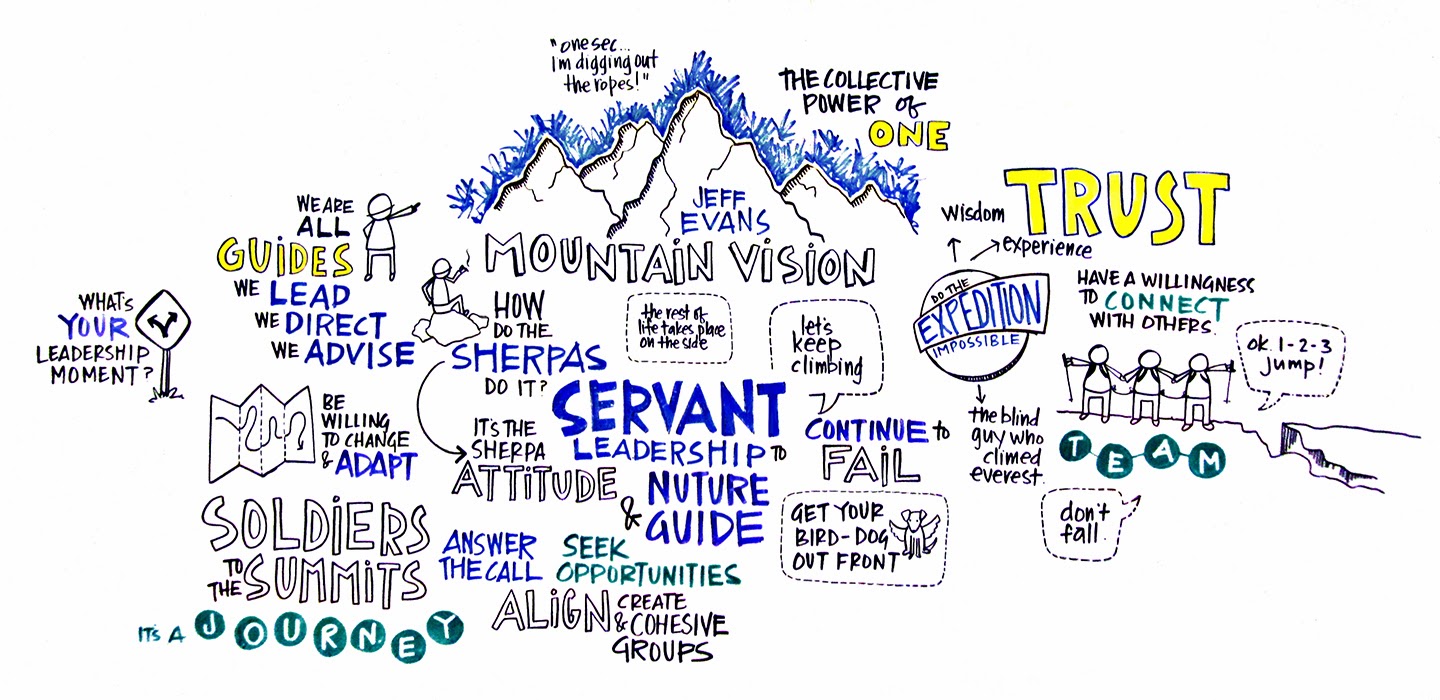
An Illustrative Look At The MountainVision Message
This amazing illustration was created during one of my recent keynote presentations. Such a wonderfully creative way to take a look at the overarching themes I share to global Fortune 500 companies.
Subscribe to:
Posts (Atom)